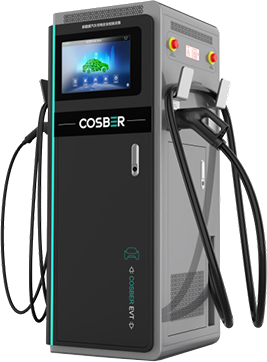

Charging Safety Tester
IE-Series

Charging Safety Tester
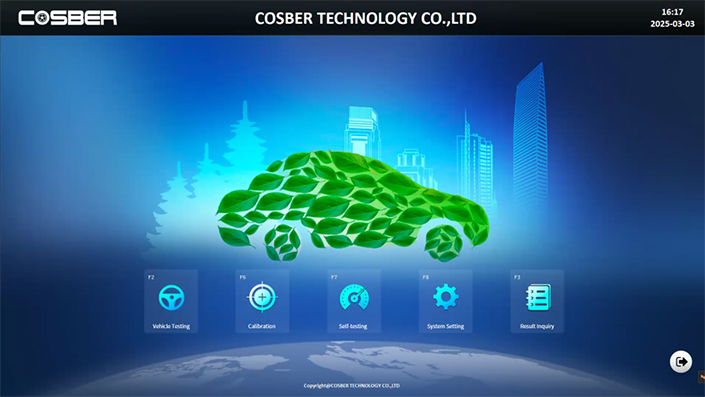
With the rapid increase in the number of electric vehicles, conducting necessary technical inspections on the electrical safety of these vehicles has become a very practical need. As the country with the largest global ownership and the fastest growth rate of electric vehicles, China has already issued national standards for mandatory electrical safety inspections of electric vehicles. In accordance with these standards, Cosber has developed a corresponding technical solution.
Support EV and PHEV with 2WD & AWD including LDV and HDV;
Reliable and trust-able technical test on electrical system and module test;
Good ability to simulate the actual dis-charging working mode;
Applicable on kinds of mainstream charging port of CCS, GB-AC/DC, ChaDoMo.
Background
According to the requirements of China’s National New Energy Vehicle Development Plan(2021-2035), Electric Vehicle becomes the main part of Automobile industry. To ensure on-road safety, charging safety, and driver safety with electric vehicles, in-use electric vehicles should be tested and evaluated using effective and pragmatic methods.

Visual checking
Whether below items has any visual damage Charging Part & Socket; Instrumentation & Signal Indicators; Power Battery; Wiring Harness & High-voltage Components;

Insulation & Equalization Test
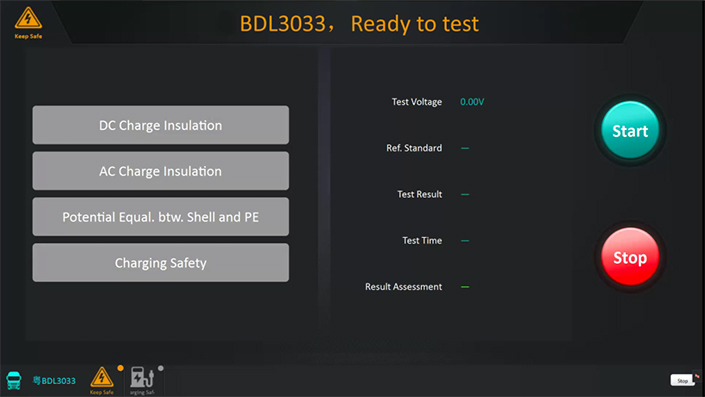
DC Charge Insulation; AC Charge Insulation; Potential Equalization Between Shell & E Platform; Potential Equalization Between Shells;

BMS Charging Test
State of Charge; Max. Temperature of Battery; Max. Voltage of Secondary Cell; Charging Simulation for State of Health;

ECU Dis-charging Test
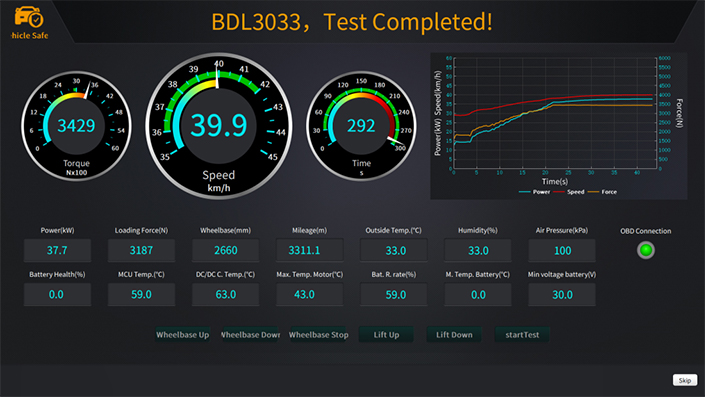
Real-time monitoring of the performance via EV-OBD Driving Motor Temperature; Motor Controller Temperature; DC/Dc Converter Temperature;
BMS Dis-charging Monitoring
Real-time monitoring of the performance via EV-OBD Max.Temperature of Battery; Min.Voltage of Secondary Cell;

Dis-Charging Simulation
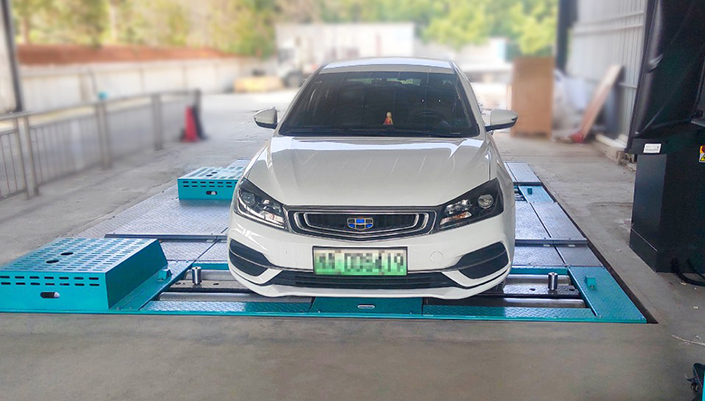
Driving at 0~130km/h on the 4WD chassis dyno; Test the basic stability of driving; EV Electromagnetic radiation Test;

The solution encompasses two core parts: charging detection and discharging detection. Charging detection, also referred to as static detection, primarily assesses the performance of potential equalization and the insulation resistance of the charging port. Discharging detection, known as dynamic detection, mainly evaluates the safety of the power battery, the drive motor, and the electronic control system.
| SL | Test Item | Value | Standard | Result | |
| Power Battery Safety | |||||
| 1 | Charging | Max. Temperature of 8 attery | 31 | ≤60℃ | PASS |
| 2 | Max. Voltage of Secondary Cell | 374 | ≤4.5V | PASS | |
| 3 | Secondary Cell Valtage Range | 000 | ≤0.3V | PASS | |
| 4 | Discharging | Max. Temperature of Battery | 31 | ≤65℃ | PASS |
| 5 | Min. Voltage of Secondary Cell | 352 | >1.8V | PASS | |
| Driving Motor Safety | |||||
| 6 | Driving Motor Temperature | 600 | ≤175℃ | PASS | |
| 7 | Motor Controller Temperature | 550 | ≤95℃ | PASS | |
| Electrical Control System Safety | |||||
| 8 | DC/DC Converter Temperature | 400 | ≤95℃ | PASS | |
| Electrical Safety | |||||
| 9 | DC Charge Insulation | 4515014.6 | ≥100Ω/V | PASS | |
| 10 | AC Charge Insulation | 1096.5 | ≥1MQΩ | PASS | |
| 11 | Poterntial Equalization Between Shell & E-Platform | 0.07 | ≤0.10Ω | PASS | |
| 12 | Pential Equalization Between Shells | 0.02 | ≤0.20Ω | PASS | |
| Remark:This is the screen shot of actual test report based on China technical regulation, and it shall be different case by case due to the different regulation and technical condition. | |||||
Introducing the Cosber’s EV Charging Safety Tester, designed for electric vehicles with European CCS-2 charging standards. This advanced equipment offers comprehensive testing and monitoring capabilities, including high voltage insulation checks, potential equalization assessments, and BMS communication analysis. Additionally, it functions as an AC/DC EV charger, providing versatility and convenience in one device.Lorem ipsum dolor sit amet, consectetur adipiscing elit. Ut elit tellus, luctus nec ullamcorper mattis, pulvinar dapibus leo.
Detection Function
| Test Function | Value Range | Standard |
| SOH | 0-100% | ≥70% |
| DC Charge Insulation | 0-2000KΩ/V | ≥100Ω/V |
| AC Charge Insulation | 0.1-1000MΩ | ≥1MΩ |
| Potential Equal. btw. EV and P.E | 0.01-20Ω | ≤0.1Ω |
| CCS-2 type DC charging capacity | 0-30kW |
Equipment Parameter
| Operational Power | AC 380V+10%,50/60HZ+5% |
| No-Load/Full Load Power Consumption | 0.2/30kW |
| Operational Environment | Temperature:0~40?°C;Humidity:20~90%RH |
| Dimension(WLH) | 600×600×1600mm |
| Equipment Weight | 150Kg |
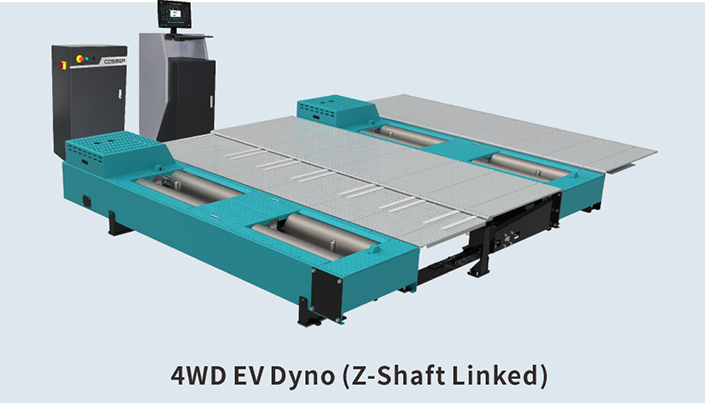
1.Z-Shaft interlinked chassis Dynamometer design for all of motion mode of Ey;
2. Real timmesynchronisation of4 wheels Drive mode avoidingthe Eletronic
Torque Control interference;
3. Automatic wheelbase adjustment mechanism for all of Light EV
(rang:2300-3300mm);
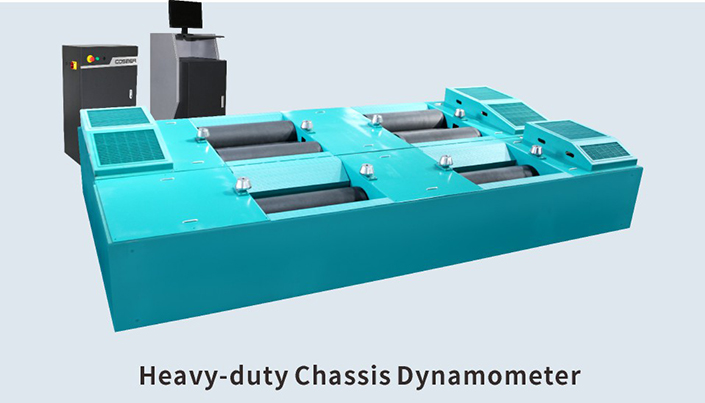
1. Ultra-heavy-duty dynamometer design, with a maximumabsorption power of
1050 kW;
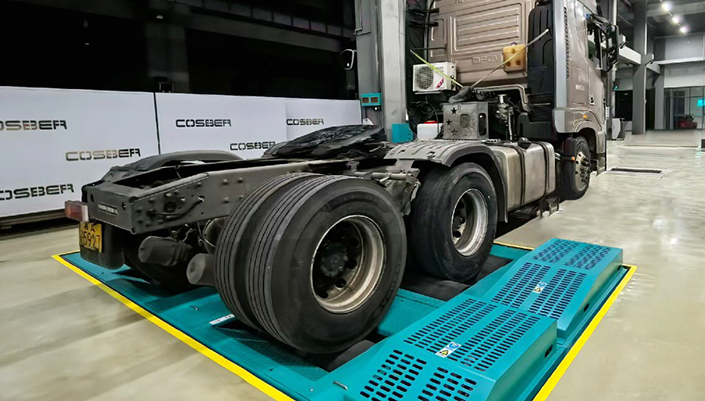
2. Dualdrive shaft roller design, compatible with all types ofheavy-duty vehicles;
3. High dynamic balance dynamometer design, covering speedtests from 0 to
130 km/h;Lorem ipsum dolor sit amet, consectetur adipiscing elit. Ut elit tellus, luctus nec ullamcorper mattis, pulvinar dapibus leo.
Dyno Bench Technical Data
| Item | 4WD EV Dyno(Z-Shaft Linked) | Heavy-duty chassis Dyno |
| Maximum carrying vehicle mass | 5000kg | – |
| Maximum bearing axle mass | 3000kg | 13000kg |
| Maximum absorption driving force | 0〜6000N×2 | 0-10000 N |
| Max. test speed | 130 km/h | 130 km/h |
| Roller diamete | Ф216mm | Ф373mm |
| Roller length | 1000mm | 1050mm |
| Inside wheel thread | 700mm | 900mm |
| Outer wheel thread | 2700mm | 2900mm |
| Minimum vehicle wheelbase | 2300mm | – |
| Maximum vehicle wheelbase | 3300mm | – |
| Eddy current rated power | 160 kw x 2 | 700 kW(max absorbtion power) |
| Back drag motor power | 7.5kW | 11 kw(transducer control) |